2026 Bradford Literature Festival: The Lost Tramways and Trolleybuses of Bradford — notes

The tramshed at the edge of the village
There's an old tramshed near our house in Saltaire. I've walked past so many times over the past 25 years — and I've always noticed the archive photos dotted around the area of trams and trolleybuses gliding along roads that now carry buses and cars.
This week I got some background into the old trams and trolleybus system, at Bradford Literature Festival talk The Lost Tramways and Trolleybuses of Bradford, given by Andy Feather, a former overhead linesman on Bradford's system. Andy also later helped establish the Trolleybus Museum at Sandtoft.
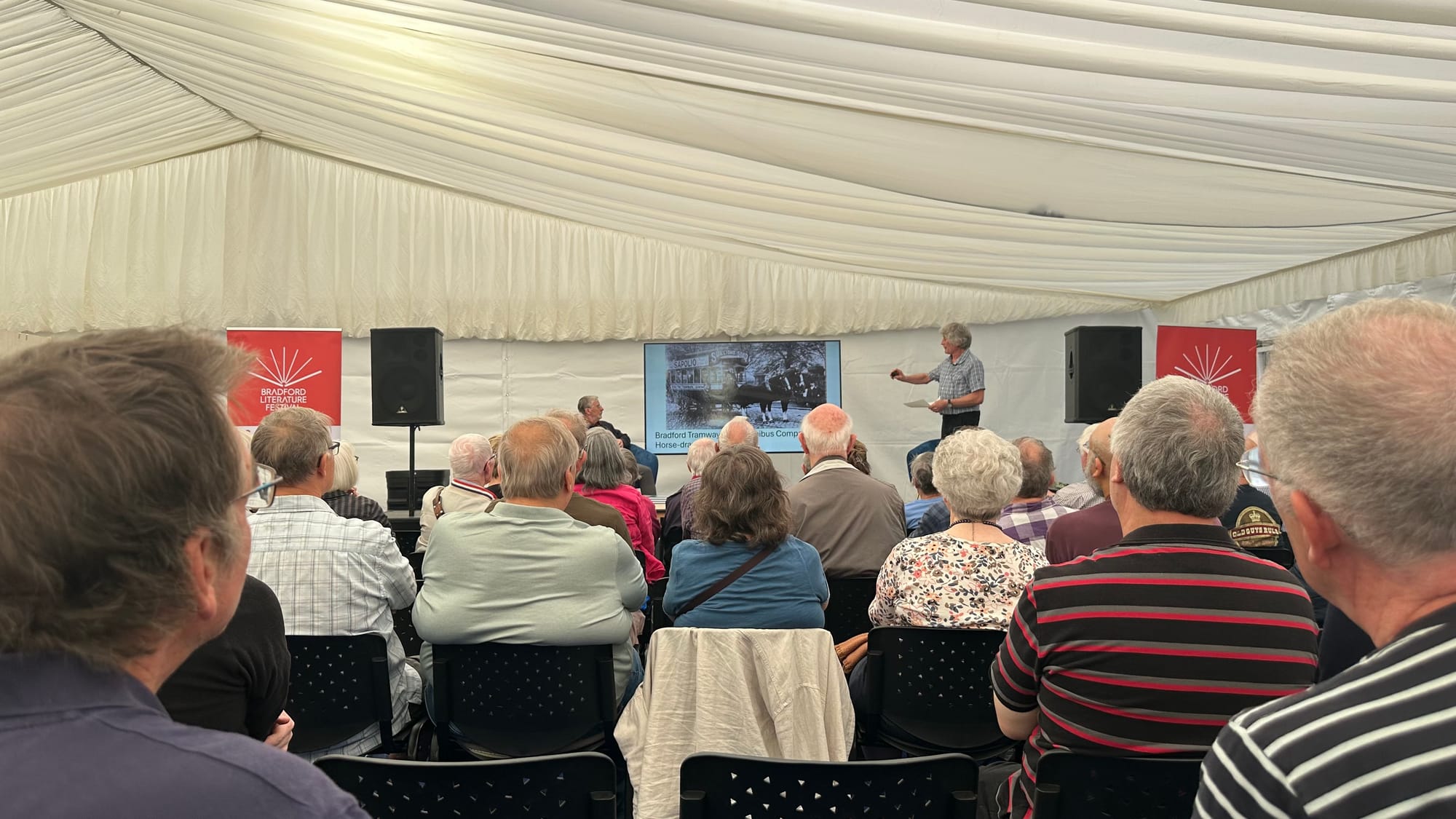
From horses to electricity
Bradford's public transport story starts in 1882, with horse-drawn trams on Manningham Lane.
At the time, the city council (then called Bradford Corporation) had the power to build tramways but not to run them, so the actual day-to-day operation was leased out to private companies, like a modern rail franchise in the UK. Steam trams followed on some of the steeper routes, run by a second private operator on the Shelf line.
That arrangement lasted until 1902, when the Corporation, keen to build a single, properly integrated network, paid to end the leases early rather than wait for them to run their course. From that point the city ran its trams directly, and by 1903 the whole system — horses and steam engines included — had been converted to electric traction.
Bradford's trolleybus pioneers
Bradford moved to trolleybuses early. The city's first service ran in 1911 (one of the first in the country, alongside Leeds), and rather than treat it as a stopgap, Bradford kept investing: new routes opened steadily over the following decades, including one that ran out to Saltaire itself in 1930.
Trams were phased out by 1950, but the trolleybuses kept going for another 22 years, finally closing in 1972. Bradford's network turned out to be the longest-running trolleybus system in Britain.
Wires, faults and stray currents
Andy spent a good chunk of the talk on the overhead wire network itself: positive and negative wires, insulation, and the genuinely tricky business of tracking down electrical faults across the city at night. There was also a fair bit on stray current, a known headache for tram systems that used the running rails as part of the electrical circuit, occasionally causing corrosion in nearby buried pipework.
One detail that stuck with me: the junction points, or "frogs," that switched trolleybuses between routes were billed as automatic. In practice, it was more of a driver's knack than a mechanism. Drawing a bit of extra power under the boom at just the right moment would trip the points electrically. Get the timing wrong, especially if you were hurrying back at the end of a shift, and they wouldn't set properly, leaving a jam for whoever came along next.
What happened to the vehicles
When the system closed in 1972, most vehicles were simply scrapped. But a group of enthusiasts had already started preserving trolleybuses as they came out of service, with nowhere yet to put them.
Land was bought at Sandtoft, near Doncaster, in 1969, and what began as a single shed has grown into the largest collection of preserved trolleybuses in the world, alongside wider transport history exhibits.
An unexpected modern echo
One of the more surprising parts of the talk was hearing how trolleybus-style technology is quietly making a comeback. Some cities are now running electric buses that charge their batteries in short bursts from overhead wires as they pass under them ("in-motion charging"), giving them the range benefits of a tram without the cost of wiring an entire route. Vancouver was mentioned as an example. Around 260 trolleybus systems across the planet are operating today, across more than 40 countries. It's a cheering thought that the technology retired from Bradford's streets in 1972 is now being reinvented, in a lighter-touch form, as a genuine option for modern cities.
In the UK seven cities have tram networks (excluding the light rail options in places like Newcastle, London's Docklands and Glasgow's Metro).
Meanwhile the West Yorkshire mass transit system keeps getting pushed back and back.
Footnote
These days the tramshed in Saltaire is a bar and brewery, currently where Salt are based and brew their beers. (Kristin and I held one part of our post-wedding do there last July.) Next time you go past you might notice the high arches over the front door. That's where the trams and trolleybuses went in and out of the building.
If you want the full, properly researched story rather than my potted playback, Andy's own book, In Search of Perfect Curves, is available from Trolleybooks.
If you fancy seeing the vehicles themselves, the Trolleybus Museum at Sandtoft holds the largest collection of preserved trolleybuses in the world, including several from Bradford. It's just off the M180 – temptingly on my route back to Grimsby when I go over for Town matches on Saturdays.