Agile Cambridge 2026 — day one — notes

I was at day one of Agile Cambridge 2026. I've written elsewhere about the chipping and the craft, inspired by the Barbara Hepworth sculpture in the venue grounds.
Here's my notes from the morning talks I went to, all of which I took a lot from.
(Apols to Mark Devis and his also excellent after lunch workshop Turning team health checks into experiments that matter – I was more in a doing mode then.)
Context, constraints and complexity
Alicia Juarrero
Seeing what you expect to see
- Frameworks shape what we notice. We miss what isn't in the frame
- Log cabins only appeared in America when Scandinavian settlers brought their practice of building with whole logs. British settlers, used to planks, never thought of it
- 9/11 "joining the dots": the dots weren't seen because they didn't fit the expected framework
- When the brain can't find a pattern, it makes up a story that fits
- AI has the same limit: good within a frame of reference, weak across frames
Beyond billiard ball causality
- Science mostly works with one model of cause: energy transfer, like billiard balls
- This can't explain how parts and wholes relate. Tissue is nothing other than its cells, but has properties the cells lack. Wholes shape their parts as well as the reverse
- "Constraint" fills the gap, but needs widening beyond "restriction"
Types of constraint
- Enabling constraints open up possibilities as well as limit them
- Context independent constraints move a system away from randomness, like a tilt in the landscape. Pure randomness never produces complexity
- Context dependent constraints link separate things into a whole with new properties, like photons forming a laser beam
- These feed each other, which is how complexity grows
- Position matters: where a cell sits in the embryo decides what it becomes
- Timing is the most overlooked: a child on a swing learns that timing, not force, makes it go higher
- Feedback is a key constraint, and central to agile
Navigating complex systems
- Look at the constraints in play and the assumptions taken for granted. Astronauts' blood and bones change without Earth's gravity, something nobody thought to question
- Institutional memory matters, for example the hospital matron as the memory of the ward
- Mohamed El-Erian: future success depends on institutional agility and operating under unfamiliar conditions
- Interfaces need to translate between frames, as a cell membrane does
- Path dependence: what you go through changes what's possible next
- Systems pushed too far from their settled state become unstable. A small fluctuation can tip them into a new regime. No guarantee it's a better one
Q&A
- Recovering stability during upheaval, such as AI and mergers and acquisitions (M&A):
- No one answer - context changes everything
- Complex systems stay steady by constantly adjusting, like a cyclist on rough ground. You only get a feel for that by being embedded in it
- Her view of the future:
- Warning sign of a failing system: swings too big for it to absorb
- Buzz Holling on the Great Lakes: low diversity looked stable until the first real stress collapsed it
- Evolution selects for resilience, not stability. "Fittest" originally meant best fit, not strongest
Further reading for me off this
- C. S. "Buzz" Holling, Resilience and stability of ecological systems (1973)
- Mohamed El-Erian, The only game in town (2016)
Navigating uncertainty in software systems
Jit Gosai, principal tester, BBC
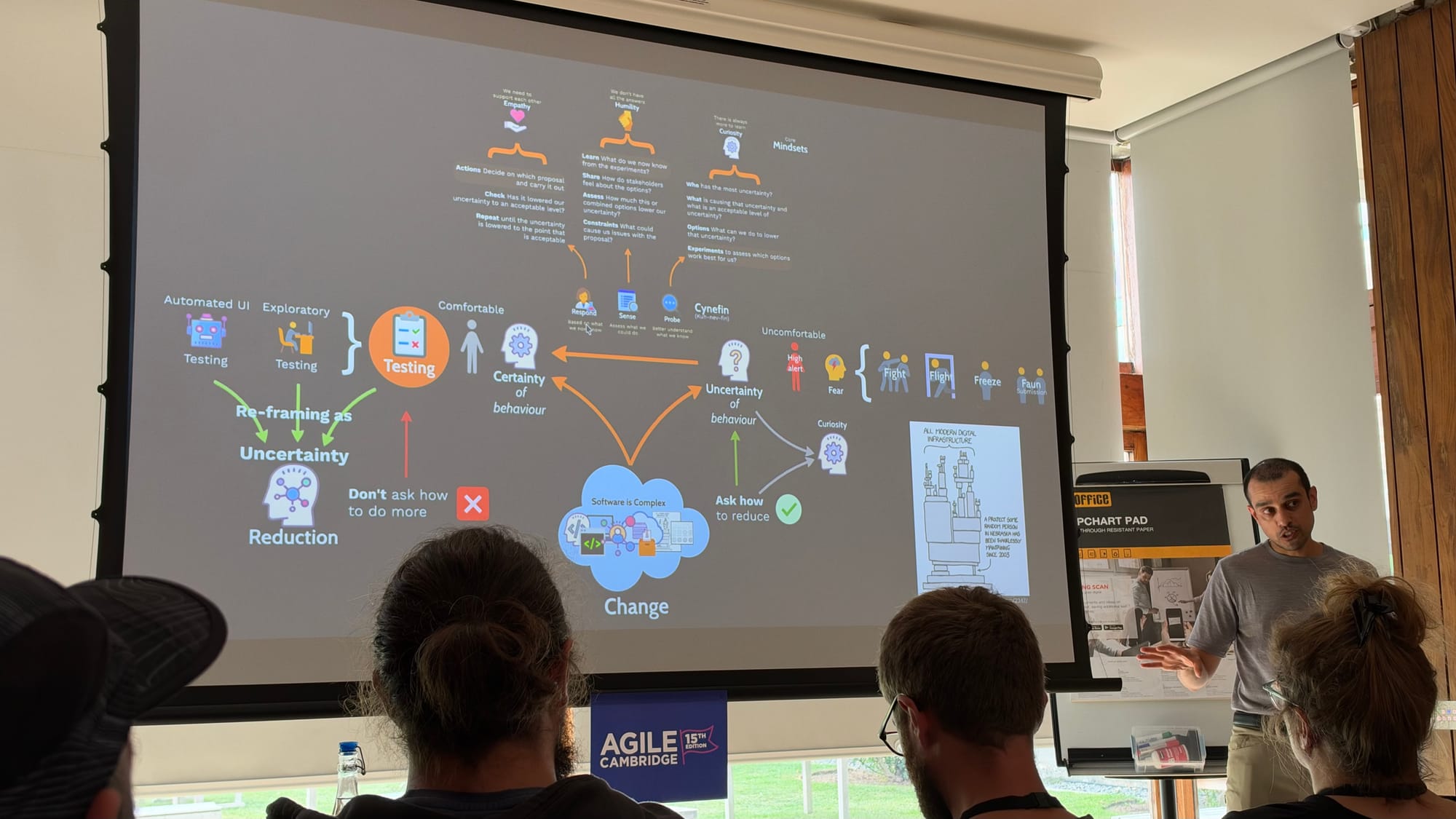
Four stories of change
- Luddites smashed machines that threatened their jobs
- Sears moved online rather than take on low cost competitors. Bankrupt in 2018
- Blockbuster turned down buying Netflix for $50 million. Bankrupt in 2010, one store left in Oregon (now a tourist attraction)
- Nokia lost the smartphone market, then sold its phone business to Microsoft for €5.44 billion. Microsoft wrote off almost all of it
Why uncertainty feels uncomfortable
- Predictable change is easy to handle. Unpredictable change is disruptive
- The brain's alarm system reacts before we've worked out what the threat is. Adrenaline puts us on high alert, cortisol keeps us there
- The same signals get read as excitement or fear. The difference is often the story we tell ourselves
- Fear responses: fight, flight, freeze and fawn (making friends with the threat). The brain can't tell a bear from a change to the team's ways of working
- Luddites fought, Sears fled online, Blockbuster froze, Nokia fawned
Change doesn't come from nowhere
- None of the iPhone's 12 key technologies were developed by Apple. The signs are usually there for some time
- Three mindsets help: humility, empathy and curiosity. Curiosity starts with asking how things work and discussing it with others
Complicated versus complex
- From the Cynefin framework: complicated things are knowable by experts (engines, code). Complex things are never fully knowable, and behaviour only emerges once they run (hospitals, businesses)
- Modern software is built on layers of other people's code, and more teams means nobody knows who knows what
- So building software is complex, and every change brings uncertainty
Testing as uncertainty reduction
- The default response is more of the same: more testers, more automation. Each adds complexity and pushes testing to the end
- The problem is framing testing as bug catching. Reframe it as uncertainty reduction: "how do I lower uncertainty?", not "how do I do more testing?"
- Zero uncertainty is impossible, but lowering it meaningfully is worthwhile
- Use Cynefin's probe, sense, respond:
- Probe: find which stakeholders are most uncertain and why, then run experiments
- Sense: share what you learned and check whether it eased the real worry
- Respond: act on the real system, check, repeat
- No best practices, only good practices. The people doing the work are best placed to decide
Q&A
- Start with where a team sees problems, not where you think they are. Sometimes let them try something you think won't work
- Two year roadmaps often rest on vanity metrics. Suggest measures that show learning
- Avoided naming practices like shift left, as they mean different things to different people
Further reading for me off this
From Zombie to Derry Girls
Alan Smith
Numbness
- Grew up in Northern Ireland during the Troubles. Searches, peace walls and soldiers felt normal until he watched Derry Girls as an adult
- The Cranberries' Zombie (from 1994) was about that numbness
- Teams living with conflict go numb too: quiet cynicism, people who used to push back going quiet. Delivery and metrics look fine, but belief, ownership and care leak away
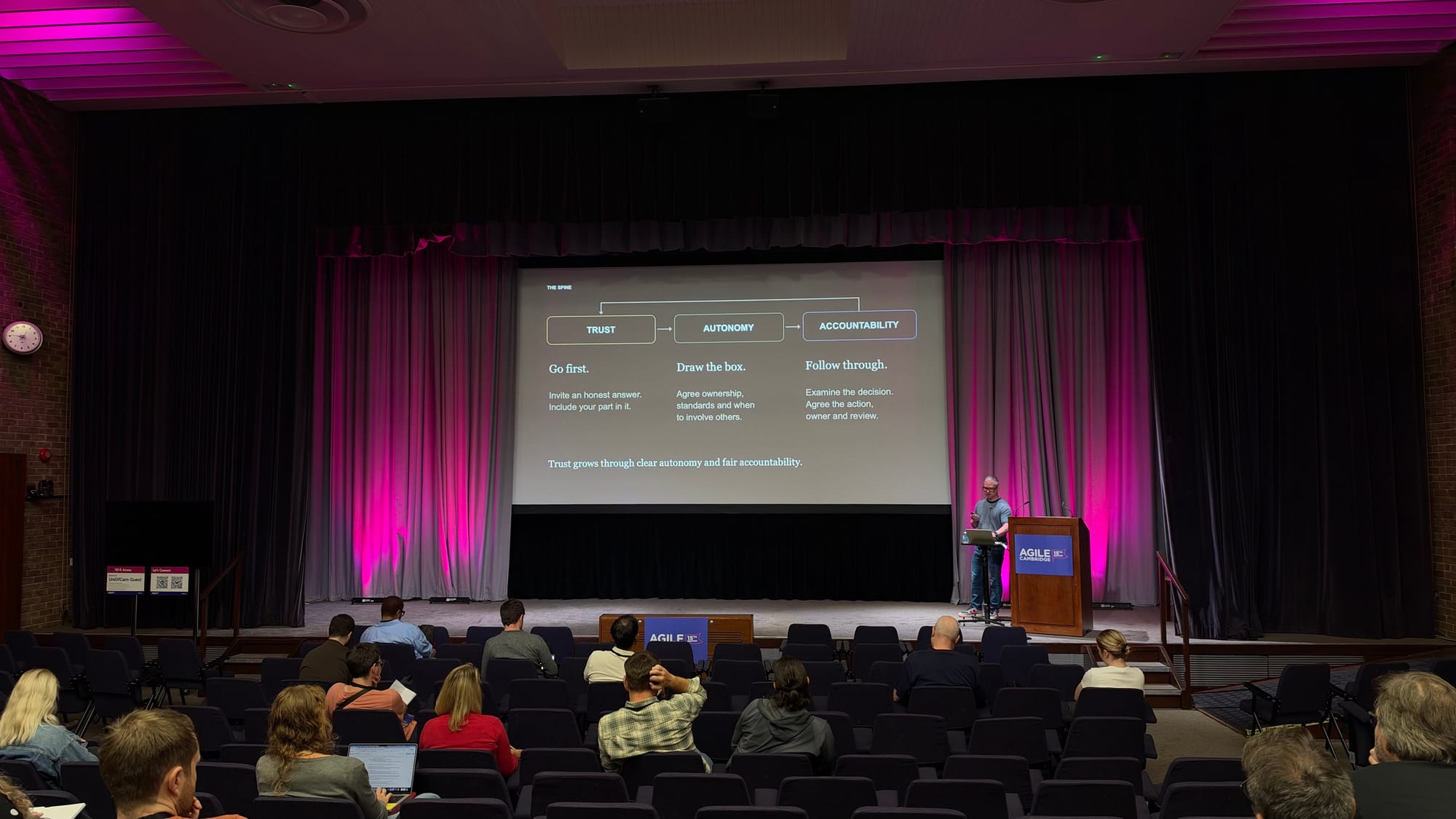
- His three values as a leader: trust, autonomy and accountability
Six signs a team has gone quiet (look for patterns and change, not any one sign)
- The meeting after the meeting: agreement in the room, concerns in DMs afterwards
- "Just tell me what you want": someone who used to bring recommendations now brings every decision
- Process as a shield: process used to end a conversation rather than make change happen
- Disagreement disappears, especially if the first suggestion is always yours
- "Fine": ask something specific instead, like "what's harder this week than last?", then sit in the silence
- Nobody asks for anything, often because past requests went nowhere
Trust: going first
- If the signs feel familiar, have a conversation without arriving with a diagnosis
- January 1998: loyalist prisoners withdrew support for the peace talks. Mo Mowlam went into the Maze prison, took off her wig, sat down and said "let's talk". Support was restored, and three months later came the Good Friday Agreement
- Going first means making the first move without knowing how the other person will respond. Going first with no risk is just being nice
- Saying "this is a safe space" doesn't make it one. People remember what happened last time
- If someone has gone quiet, name what you've noticed and ask if you've played a part. If it's you, don't explain it away or rush to apologise. Ask more, then act on it
- Be predictable. Ask rather than guess
Autonomy: draw the box
- "I trust you" followed by "I wish you'd come to me" sends the team back to checking everything
- Autonomy without clarity isn't empowerment, it's abandonment
- Draw a box: what's yours, what's mine, what good looks like. Consulting means getting input, not a hidden approval step
- The hard part is backing a reasonable choice you wouldn't have made
Accountability: not whose fault
- Naming who made a change doesn't tell you whether the decision was reasonable or the process helped
- Don't let the outcome decide what the rule should have been
- After an incident, the manager owns their part first and asks what the engineer knew at the time. The aim is to understand what happened, not to get a confession
- Agree changes, then check they helped
The loop
- Trust, autonomy and accountability reinforce each other. A loop, not a sequence, so start anywhere
Closing
- Derry Girls showed the absurd beside the frightening. Being used to things that weren't normal didn't stop people being alive to each other
- Dashboards can sit on top of a team that's gone quiet. Listen for candour with warmth, and for the quiet person speaking again
Q&A
- Teams stuck in understanding, never acting: possibly an accountability vacuum, where nobody owns the next step
- Offering trust down but not getting it from above: not sustainable long term
Further reading for me off this
- Mo Mowlam, interview on the Maze prison visit
- Google re:Work, Understand team effectiveness
Themes
- Context over best practice. There's no one answer, and the people doing the work are best placed to decide – so start with a conversation rather than a diagnosis
- Not seeing what's in front of you. We see what we expect and get used to things that aren't normal, so a team can go quiet while the dashboards look fine
- How people react when they can't predict or influence things, from fight, flight, freeze and fawn to numbness and going quiet
- Complexity can't be fully known, only worked with. Small changes can tip a system into something new, and behaviour only shows once it runs
- Constraints that enable. A clear box around decisions opens up possibilities rather than just limiting them
- Feedback loops. Probe, sense, respond and repeat, and treat trust, autonomy and accountability as a loop, not a sequence