Product for the People 2026 lightning talk: From A to Z — notes

I gave a lightning talk at Product for the People in Bristol on 3 September. The brief was five minutes. I don't think it was recorded anywhere so here's a quick write up. The slides are here.
It's a bit of a grind, what we do and what we're involved with. So I wanted to end on a hopeful note: that sometimes you don't know where the grind will go.
I'd spent three and a half hours in a CrossCountry sweatbox the night before. I came out of Temple Meads, walked across the Bristol to Bath cycle path, and started thinking about the ground I was standing on — which used to be a railway and is now used for people to cycle along.
Infrastructure is fascinating to me, particularly at a time like now, when so much of what we're building sits on and around infrastructure that has been in place for such a long time. Plenty of people find this stuff boring. I call it interesting.
So the question I took into the talk was this: how much of what we use was actually built for what we use it for?
The intended use wears out. The route doesn't. The route gets handed down, repurposed, long after everyone who paid for it has gone.
Here's eight examples, six oldies, two newies. (There could have been so so so many more.)
The Bristol and Bath Railway Path
Let's start with what started me thinking about this, the one I'd walked across the night before. A mainline railway, closed in the early seventies under the Beeching reforms. Sustrans – an organisation local to Bristol – dug it out, surfaced it, and it became the first bit of what's now the National Cycle Network.
Thousands of commuters a day, on what was originally built for steam engines.
Canals
Private money, dug by hand, to move coal. It starts with the Bridgewater Canal in 1761, which carried a Duke's coal into Manchester and halved the price of the coal.
Sixty years of speculative mania followed as we dug about four thousand miles of these things. Then the railways arrived – and the whole thing was over inside a lifetime.
Today the canal towpaths are part of a walking and cycling network, and underneath it there are utilities. The Canal and River Trust leases those corridors under towpaths and bridges for broadband, gas and electricity – and sells heating and cooling drawn from the water itself.
Telegraph poles

We spent a fortune putting wooden poles across the country to carry telegraph wires, and then telephone lines.
When full fibre came along, instead of digging up the pavements and roads all over again (like we did about 20-25 years ago), the cheapest way to reach a house turned out to be the pole already standing outside it.
The fastest connection most people can buy arrives on a stick planted before the war.
Bournemouth's sewers
One of my favourite failures.
In 2007 Bournemouth ran fibre through the town's sewers rather than digging up the roads.
The council reported the work going about 80 per cent faster than the usual method, and the cable was armoured against rats. Then it stalled.
The water company pulled out over the contractual terms, what it was getting in return for hosting the cables. The scheme never got past a pilot linking the town hall to the conference centre. (My other favourite thing: A pilot that actually stopped. How often do we see that?)
Nothing engineering related killed it.
With the sewer agreement gone, the company fell back on micro-trenching — which meant digging up the town's pavements and roads anyway, taking all the complaints from residents that going through the sewers was supposed to avoid. They lost the clever route and got the disruption.
(The company involved later ran into all sorts of money mismanagement problems, but that's not for this talk.)
Cold War bunkers
They make good data centres.
Thick concrete, deep ground, controlled access, and power and cooling already run in.
Salts Mill
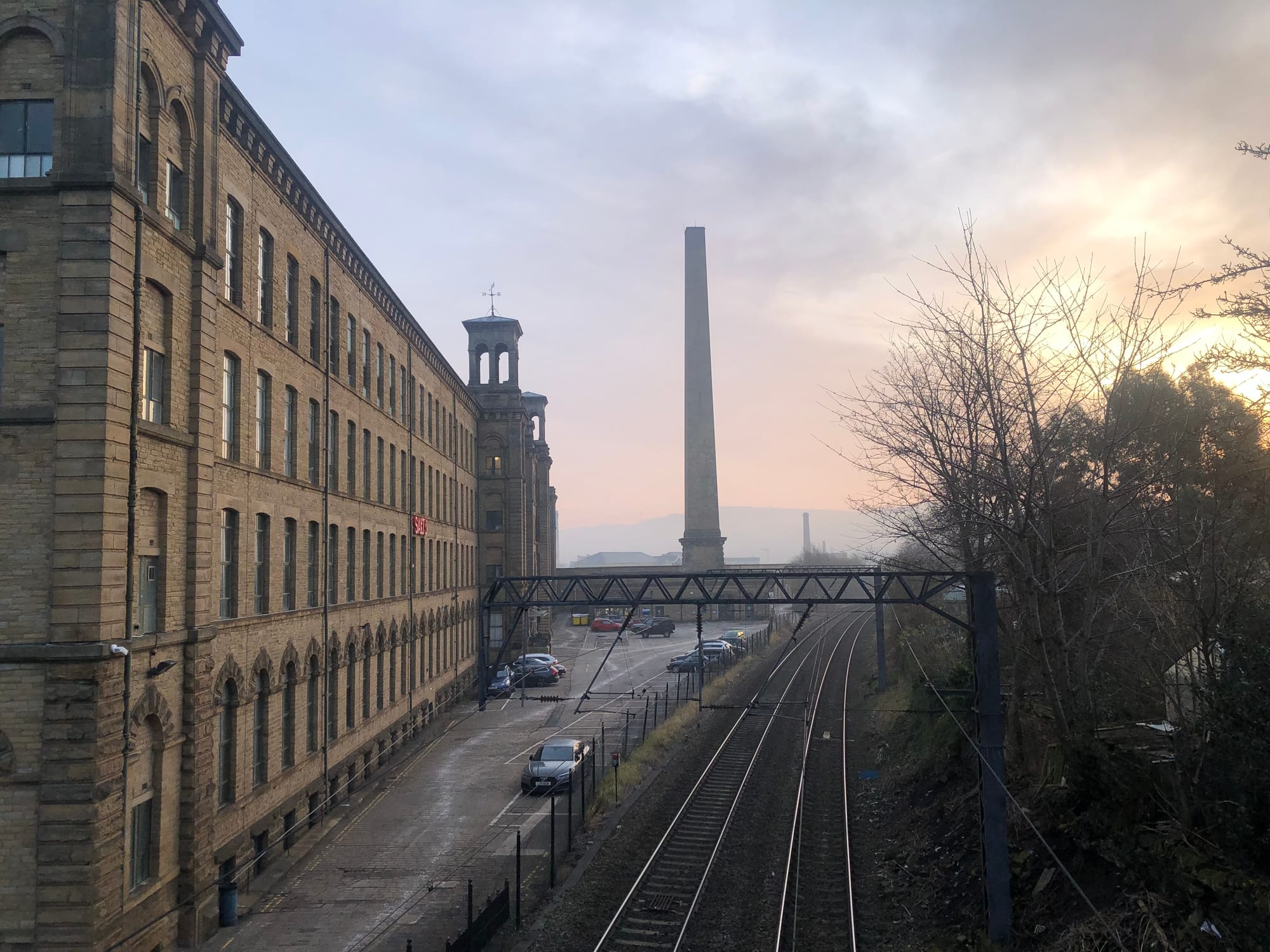
Where I live, Saltaire, Titus Salt built the largest factory in the world for spinning alpaca wool. Opened in 1853, it stopped manufacturing textiles in 1986.
It has now become a David Hockney gallery, a bookshop, and from 1987 the offices of Pace — the company that designed and built the digital set-top boxes that Sky and others used in their early years, an unobvious infrastructure.
And then there's... HS2
An example of new infrastructure.
HS2 or HS3 or whatever we're calling it, was approved in 2012 at about £33 billion – and was due to open this year.
As of May this year, finishing it is costed at up to £103 billion. The first trains are expected somewhere between 2036 and 2039, ten to thirteen years on from the original plan.
The route has been cut, the eastern leg to Leeds gone and the land is being sold back to the people it was bought from.
The Humber Gateway Wind Farm
The one I'm most fond of, because it's near my hometown.
Grimsby's fish docks were built for a fleet that isn't there any more.
Humber Gateway sits 8km off the east coast near Grimsby, 73 turbines, enough for something like 199,000 homes, fully operational since 2015.
Its operations and maintenance base is on North Quay, on Grimsby Fish Dock, a site that had sat disused for years – used only for things like filming Atonement – before they built the office, the stores and the vessel moorings there.
It was developed by a subsidiary of E.ON, now owned by RWE and Greencoat, an energy company and an investment fund.
What I take from it
Any infrastructure that actually gets made and then performs well is a small miracle. It's funny how much of what we rely on now turns out to be originally so old.
I'm curious about how these things came about — how they were innovative, and brave, and (mostly) business-driven.
Nobody dug the Bridgewater canal for the good of the nation. They dug it to shift coal cheaply. Getting a walking route and a fibre corridor two hundred years later is an accident.
And not everything that is public infrastructure needs to be designed and made by public bodies. A lot of the examples I gave were private ventures. It's OK to buy things in.
Which is what I keep turning over. As product people we talk endlessly about outcomes. How many of the outcomes those old bits of infrastructure contribute to today could anyone have predicted at the time? None of them, I'd guess.
So when I look at HS2 and HS3 and whatever comes next, the interesting question – aside from what state they will actually be in once completed – isn't whether they'll deliver the benefits case. It's what a generation or two down the line will find they can build on.
It's a bit of a grind, what we do. Sometimes you don't know where the grind will end up. And that's interesting and exciting.
Footnote
The slides are here.
Thanks to Matt Jukes for his open brief. 😄
And feel free to let me know your favourite examples of reused or new infrastructure!